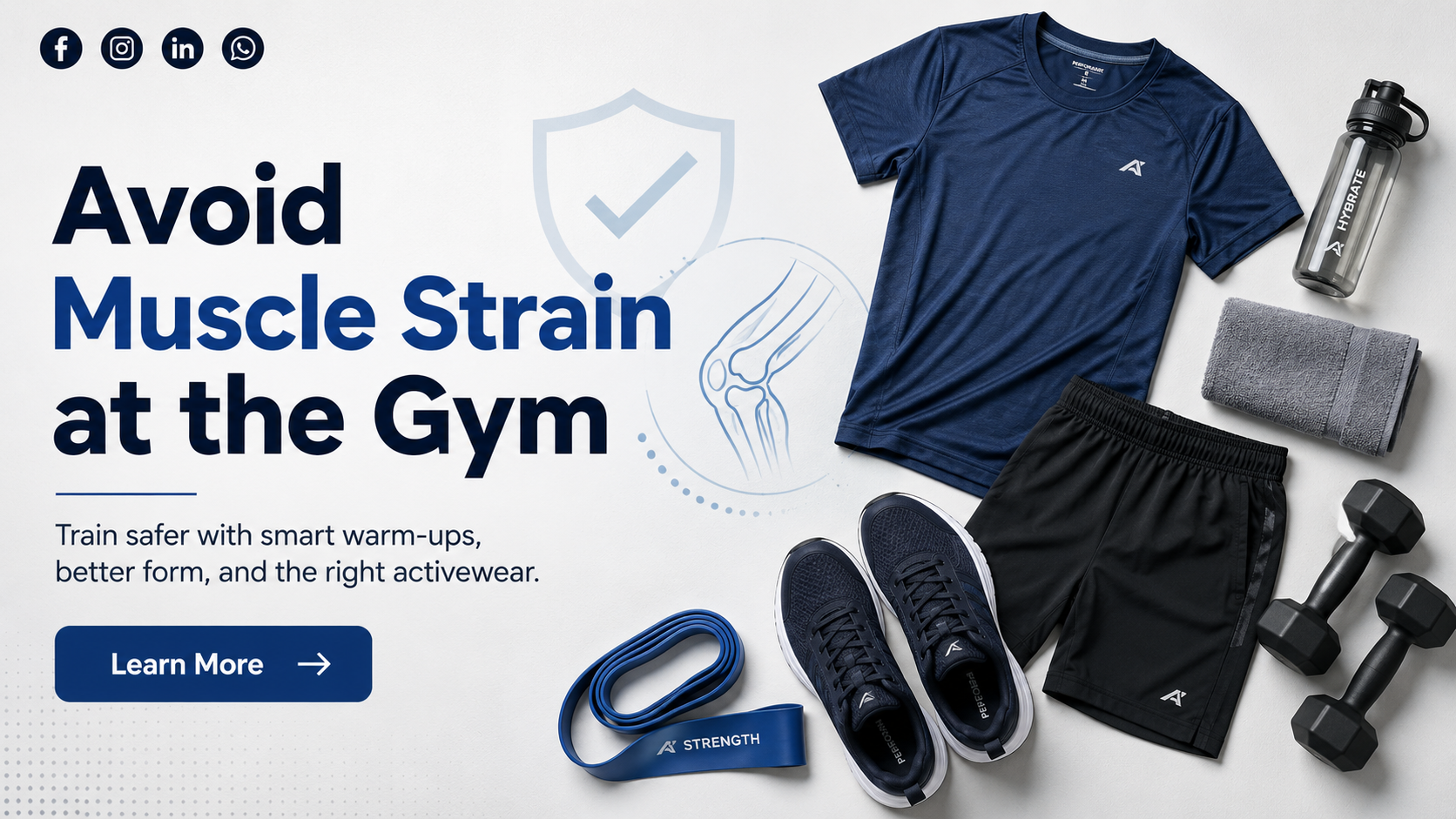
A muscle strain can happen in seconds. You may rush into a heavy set, lift more weight than you can control, use poor form, or continue training when your muscles are already tired.
Preventing muscle strain during a workout is not simply about stretching for a few minutes. It requires the right warm-up, controlled movement, suitable weight, proper recovery, and gym clothes that allow your body to move freely.
This guide explains exactly what to check before, during, and after your workout so you can train with more confidence and reduce unnecessary injury risk.
Important: This article provides general fitness information and does not replace medical advice. Speak with a healthcare professional if you have an existing injury, ongoing pain, or a health condition that affects exercise.
Muscle Soreness or Muscle Strain: Know the Difference
Many people continue exercising because they believe every type of pain is normal. However, regular post-workout soreness and a muscle strain do not usually feel the same.
A muscle strain happens when muscle fibres or the tendon connected to the muscle are overstretched or torn. An acute strain can cause immediate pain, weakness, swelling, muscle spasms, or limited movement.
Use this comparison as a quick guide:
| What you notice | Normal post-workout soreness | Possible muscle strain |
| When it appears | Usually develops after the workout | May happen suddenly during a movement |
| Where you feel it | Often across the trained muscle group | Usually focused in one specific area |
| Type of discomfort | General stiffness, tenderness, or aching | Sharp, pulling, tearing, or intense pain |
| Movement | Uncomfortable but normally possible | May feel weak, unstable, or difficult |
| Other signs | Usually no major swelling or bruising | Swelling, bruising, spasms, or reduced movement may occur |
This table cannot diagnose an injury. When pain is sudden, severe, or affects normal movement, stop the exercise rather than trying to complete the set.
1. Run a 60-Second Body Check Before Training
Before picking up a weight, take one minute to assess whether your body is ready for the planned session.
Ask yourself:
- Do I already feel pain in the muscle or joint I plan to train?
- Am I unusually tired because of poor sleep, illness, travel, or physical work?
- Is one side of my body feeling weaker or tighter than the other?
- Am I returning after several days or weeks away from training?
- Can I perform the basic movement without pain?
For example, before a leg workout, perform a few slow bodyweight squats. Before an upper-body session, raise both arms overhead and move your shoulders gently.
This is not a full medical assessment. It is a simple way to notice obvious discomfort before adding speed, load, or resistance.
When your body feels different from normal, adjust the session. You can reduce the weight, shorten the workout, choose a less demanding movement, or take an additional recovery day.
2. Warm Up for the Workout You Are Actually Doing
A few random arm circles are not enough preparation for every workout.
Your warm-up should gradually increase your body temperature and prepare the muscles and movement patterns you are about to use. Health guidance commonly recommends beginning with approximately five to ten minutes of light activity before moving into more specific exercises.
Here is a more specific approach:
| Planned workout | General warm-up | Movement-specific preparation |
| Leg training | Brisk walking or light cycling | Bodyweight squats, reverse lunges and light squat sets |
| Chest and shoulders | Easy rowing or walking | Arm circles, shoulder movements and light pressing |
| Back training | Light rowing or cycling | Controlled band rows and light pulling exercises |
| Running | Brisk walking | Leg swings, easy jogging and gradual speed increases |
| Full-body training | Walking, cycling or rowing | Light versions of the main exercises in your workout |
A warm-up should make you feel prepared, not exhausted. You may feel warmer and begin to sweat lightly, but you should still have enough energy for the main workout.
Do not treat static stretching as your entire warm-up
Holding a muscle in one stretched position is not the same as preparing it for loaded movement. Stretching cold muscles may cause discomfort, so begin with light movement first. Dynamic movements are generally more suitable immediately before training because they prepare the joints and muscles through movement.
3. Use Warm-Up Sets Before Heavy Lifting
Finishing five minutes on a treadmill does not mean you should immediately begin your heaviest squat, bench press, or deadlift set.
Warm-up sets allow you to practise the movement, check your form, and prepare for increasing resistance.
Suppose your main squat sets use 60 kg. A gradual preparation might look like this:
- Bodyweight squats for controlled repetitions
- Empty bar squats
- A light set at approximately half your working weight
- A moderate set with fewer repetitions
- Your planned working sets
This is only an example. The number of warm-up sets will depend on your strength, experience, exercise choice, and working weight.
As the weight increases, reduce the repetitions in your warm-up sets. The goal is to prepare for the lift without tiring the muscles before the main work begins.
4. Choose Weight Based on Control, Not Ego
A weight is not suitable simply because you can move it from the starting point to the finishing point.
It may be too heavy when:
- You need to swing or jerk your body to complete the repetition.
- Your range of motion becomes shorter with each repetition.
- You cannot control the weight while lowering it.
- Your posture changes significantly.
- Another muscle group takes over the movement.
- You feel sharp pain rather than normal muscular effort.
For example, during a biceps curl, excessive leaning and swinging may mean the weight is beyond what your arms can control. During a squat, your knees collapsing inward, heels lifting, or lower back losing position may signal that the load, depth, fatigue level, or technique needs adjustment.
The final repetitions of a set can feel difficult, but difficulty should not completely remove control.
5. Control the Lowering Part of Every Repetition
Many gym injuries do not happen because of the exercise itself. They happen because the movement becomes rushed and uncontrolled.
Do not simply drop the weight into the bottom position. Control both parts of the repetition:
- The lifting or pushing phase
- The lowering or returning phase
Mayo Clinic advises moving weights in a controlled way instead of rushing or relying on momentum.
Consider a dumbbell chest press. Lowering the dumbbells too quickly can move the shoulders into a position you are not ready to control. During a Romanian deadlift, dropping rapidly into the bottom position may place more demand on the hamstrings and lower back than expected.
Use a speed that allows you to feel where the weight is moving. When you can no longer control the movement, end the set or reduce the resistance.
6. Check Your Exercise Position Before Adding Weight
Small setup errors can become larger problems after several repetitions.
Before starting a set, check three things:
Your starting position
Make sure your feet, hands, back, and head are placed correctly for the exercise. Your position should feel stable before the weight moves.
Your joint alignment
Your joints should follow a controlled path that suits the exercise and your body. Avoid forcing a movement into a position that causes pinching, sharp pain, or loss of control.
Your breathing and core control
Do not rush the first repetition. Take a moment to create a stable position and breathe in a controlled way.
When you are learning a new exercise, start with light resistance. A trainer or qualified fitness professional can help you understand the correct setup for your body and training goal.
7. Adjust Gym Machines to Match Your Body
Gym machines are not automatically safe just because they guide the movement.
The seat, pads, handles, and range settings may have been adjusted for the previous person. Starting without checking them can place you in an awkward position.
Before using a machine:
- Set the seat so the machine’s moving joint is reasonably aligned with your joint.
- Position support pads securely without creating painful pressure.
- Make sure you can reach the handles without overstretching.
- Select a light starting weight.
- Perform one slow test repetition.
- Stop and readjust if the movement feels forced or uncomfortable.
For example, on a leg-extension machine, the knee position and lower-leg pad should be adjusted before increasing the load. On a chest-press machine, the handles should not force your shoulders too far behind your body at the start.
Never copy another person’s machine settings without checking whether they suit your height and movement.
8. Stop the Set When Your Form Changes
Many people decide how many repetitions they will perform before the set begins. They then force themselves to reach that number even after their form has broken down.
A safer approach is to treat your planned repetition number as a target, not a command.
End the set when:
- Your body begins to swing.
- Your posture changes noticeably.
- You lose control of the lowering phase.
- Your range of motion suddenly decreases.
- You feel pain in a joint or a specific part of the muscle.
- You need another person to complete repetitions that were not planned as assisted repetitions.
Fatigue is expected during training, but repeated poor-quality movement can place stress in areas that were not meant to handle it.
Two controlled repetitions are usually more valuable than several rushed repetitions performed with poor form.
9. Do Not Train the Same Tired Muscle Repeatedly
Muscles need time to recover from demanding training.
Strain risk may increase when you repeatedly load a tired muscle, perform too much volume, or return to intense training before an existing strain has healed. Repeated movements and excessive exercise are recognised causes of overuse-related muscle problems.
Pay attention to your total training load, not only the name of the workout.
For example, your triceps may work during:
- Chest presses
- Shoulder presses
- Push-ups
- Dips
- Direct triceps exercises
Although these exercises appear in different sections of a workout plan, they can still place repeated demand on the same muscles.
When performance drops sharply, movement becomes unstable, or a muscle remains unusually painful, adding more sets may not improve the workout.
10. Wear Activewear That Allows Natural Movement
Workout clothing cannot guarantee that you will avoid a muscle strain. However, unsuitable clothing can distract you, restrict your movement, slide out of place, or interfere with gym equipment.
Before training in new activewear, perform a simple movement test:
| Movement test | What to check |
| Deep bodyweight squat | The waistband stays secure and the fabric does not restrict the hips or knees |
| Forward lunge | The shorts or leggings allow a comfortable stride |
| Overhead reach | The top does not pull tightly across the shoulders |
| Hip hinge | The clothing stays covered, secure and comfortable |
| Light jog or jump | The clothing does not slide, twist or require constant adjustment |
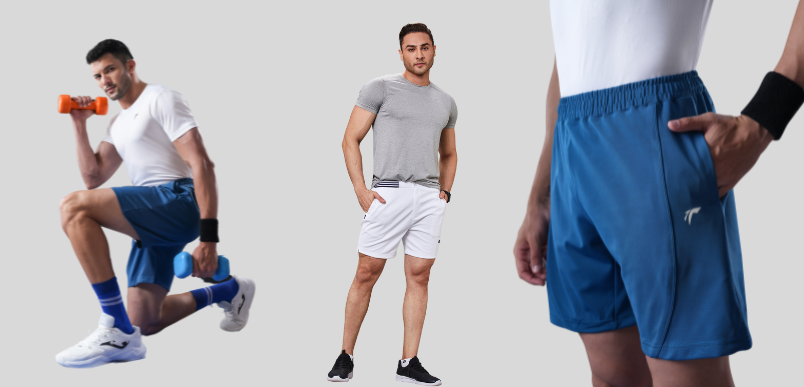
For strength training, look for activewear that provides:
- Enough stretch for your normal range of motion
- A secure fit that does not require repeated adjustment
- Breathable or moisture-managing fabric
- Seams that do not cause irritation during repeated movement
- A design that is not excessively loose around moving equipment
Leg-day clothing should allow comfortable squats, lunges, and hip movements. Upper-body activewear should let you raise, pull, and rotate your arms without tightness around the shoulders or upper back.
Your gym clothes should support the session quietly. You should not have to stop between repetitions to pull down a shirt, lift a waistband, or untangle loose fabric.
11. Know When Pain Means “Stop”
There is a difference between a muscle working hard and a warning sign that should not be ignored.
Stop the exercise when you experience:
- Sudden or sharp pain
- A pulling, tearing, or popping feeling
- Immediate weakness
- Rapid swelling
- Loss of normal movement
- Pain that becomes worse with every repetition
Muscle strains may cause tenderness, swelling, weakness, spasms, bruising, and limited movement.
Do not test the painful area repeatedly with heavier weights to see whether the pain disappears. Stop loading it and seek professional advice when symptoms are severe, movement is significantly limited, swelling is increasing, or you cannot use the affected limb normally.
12. Progress Slowly After a Training Break
Returning to the gym after a holiday, illness, injury, or long break can be misleading. You may remember your old working weights, but your current strength, movement control, and recovery ability may be different.
Do not try to prove your previous fitness level in the first session.
For your first few workouts:
- Use a lighter load than your previous working weight.
- Perform fewer total sets.
- Leave additional repetitions in reserve.
- Avoid testing maximum strength.
- Give your body time to adapt before increasing volume.
Increase one training factor at a time. For example, add a small amount of weight while keeping the number of sets the same. Avoid increasing the weight, sets, repetitions, frequency, and workout duration all at once.
Gradual progression allows muscles and supporting tissues to adapt to training demands. ACSM guidance also emphasises individualising training load and volume rather than applying one demanding plan to everyone.
Use a Simple Post-Workout Recovery Check
Your workout does not end immediately after the last heavy set.
Spend a few minutes reducing the intensity gradually. For example, walk slowly after running or perform a light final movement after an intense cardio session. Cooling down helps your heart rate and body temperature return toward normal levels.
After training, ask:
- Did any exercise cause sharp or unusual pain?
- Did one side feel weaker than normal?
- Did my form repeatedly break down?
- Am I training the same muscle again before it has recovered?
- Do I need to change the weight or exercise next time?
Also support your recovery with enough sleep, regular meals, fluids, and rest between demanding sessions. These habits do not make injuries impossible, but they help you arrive at the next workout better prepared.

Quick Pre-Workout Muscle Strain Prevention Checklist
Use this checklist before starting your main workout:
| Check | Yes or no? |
| I can perform the basic movement without sharp pain | |
| I completed a general and exercise-specific warm-up | |
| I tested the movement with light resistance | |
| I can control the weight without swinging or jerking | |
| My gym clothes allow a comfortable range of movement | |
| The equipment is adjusted to my body | |
| I know which warning signs will make me stop the set | |
| My planned workout matches my current energy and experience |
When several answers are “no,” make an adjustment before continuing.
Frequently Asked Questions
Q1. How can I prevent muscle strain during a workout?
Begin with a gradual warm-up, perform lighter preparation sets, use a manageable weight, maintain controlled form, and stop when fatigue changes your movement. Increase your training load gradually instead of making sudden jumps.
Q2. How long should I warm up before going to the gym?
A general warm-up commonly lasts around five to ten minutes, followed by movements and lighter sets that prepare you for the specific workout. The exact time may vary according to your age, environment, workout intensity, mobility, and exercise choice.
Q3. Does stretching prevent every muscle strain?
No single warm-up or stretching routine can prevent every injury. Dynamic movement and activity-specific preparation are generally more useful before exercise than stretching cold muscles. Static flexibility work can be performed gently after warming up or after the workout.
Q4. How do I know whether my gym weight is too heavy?
The weight may be too heavy when you cannot control the lowering phase, your range of motion becomes shorter, your posture changes, or you need to swing your body to finish the repetition.
Reduce the resistance and check whether you can perform the movement properly.
Q5. Should I continue working out with sharp pain?
No. Stop the exercise when you experience sharp, sudden, or increasing pain. Do not attempt to push through a possible injury. Seek medical guidance when the pain is severe, movement is limited, or symptoms such as significant swelling or weakness develop.
Q6. Can tight gym clothes cause muscle strain?
Tight clothing does not automatically cause a strain, but clothing that restricts your normal range of motion can affect comfort and movement quality. Choose gym wear that allows you to squat, lunge, hinge, push, and pull without feeling restricted.
Q7. What should beginners do to avoid gym injuries?
Beginners should learn the correct exercise setup, begin with light resistance, increase training gradually, use machines correctly, and avoid copying the weights or routines of experienced lifters.
Train Hard, but Keep Every Repetition Under Control
Avoiding muscle strains at the gym is not about training fearfully. It is about preparing properly and recognising when your body is no longer moving well.
Warm up for the workout you are doing. Build up to heavier weights gradually. Control each repetition, adjust equipment correctly, and stop when pain or poor form appears. Wear comfortable activewear that gives your shoulders, hips, and knees enough room to move naturally.
The strongest workout is not always the one with the heaviest weight or the highest number of repetitions. It is the one you can complete with control, recover from properly, and safely build upon in your next session.